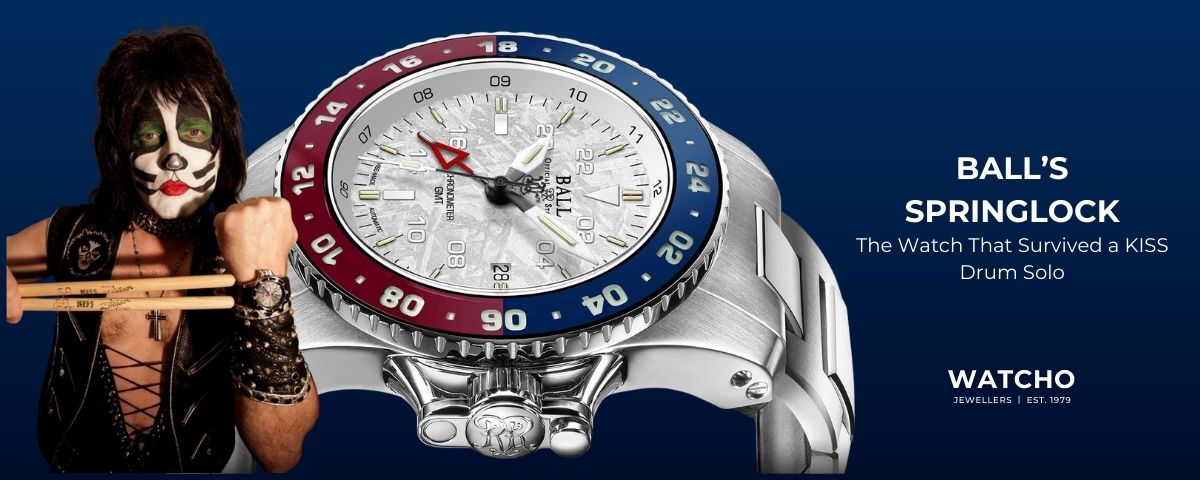
There are plenty of reasons to like Ball Watch Company. The heritage is real. The night-time legibility is almost absurdly good. And the whole brand has a refreshing, no-nonsense attitude to watchmaking.
Ball was born on the American railroads, where accuracy wasn’t a marketing slogan. It was a matter of life and death. Miss your timing, and trains collided.

But today, we’re not here to talk about history or lume. We’re here to talk about toughness. Specifically, how Ball builds mechanical watches that can take punishment most luxury timepieces simply can’t.
And yes, this involves KISS. And a drum kit. And forces violent enough to destroy watches worth tens of thousands.
Let’s get into it.

No matter how beautifully finished or expensive a mechanical watch is, they all share the same fragile Achilles’ heel: the hairspring.
The hairspring is a tiny coiled spring, thinner than a human hair, that breathes back and forth several times a second to regulate time. It’s a marvel of micro-engineering. It’s also incredibly delicate.
A sudden shock can be all it takes. Dropping your watch on a hardwood floor. Swinging a golf club. A hard knock against a table. Even clapping aggressively at a concert.
When the hairspring tangles or deforms, that’s it. Your beautifully made mechanical watch stops keeping proper time and becomes a very expensive paperweight.
Most brands solve this problem by telling you to “be careful”.
Ball decided to solve it properly.

Ball’s answer is a patented system called SpringLOCK®.
The simplest way to think about it is as a protective cage that surrounds the hairspring. When the watch takes a hard impact, SpringLOCK physically limits how far the spring can flex and unfurl.
Instead of letting all that shock hit the hairspring directly, the system absorbs and disperses it, reducing the force by an impressive 66 per cent.
That’s not marketing fluff. That’s physics.
And Ball didn’t just test this in a lab with neat charts and controlled conditions. They decided to try something far more brutal.
They strapped their watches to the wrists of professional drummers.
Including one from KISS.

Eric Singer, the legendary drummer for KISS, isn’t just a rock icon. He’s also a serious watch collector. So serious, in fact, that he’s served as a jury member for the Grand Prix d’Horlogerie de Genève.
For decades, he had one strict rule: never wear a mechanical watch on stage.
Professional drumming is a death sentence for watches. Especially during rimshots, where the drum head and rim are struck at the same time. These impacts create violent, localised shocks of over 1,000 Gs.
In a typical two-hour set, a normal luxury watch will either start gaining minutes of time or suffer catastrophic damage to the hairspring. Often both.
Singer knew this. He’d seen it happen repeatedly.
So when Ball approached him in 2013 with a challenge, he was understandably sceptical.
Ball gave Singer two watches.
One was a standard mechanical watch. The other was a Ball Engineer Hydrocarbon Airborne fitted with the new SpringLOCK® system.
Singer wore both during high-intensity soundchecks and full live concerts. Loud. Heavy. Violent. Pyrotechnics included.
The result was immediate and decisive.
The standard mechanical watch “whacked out” almost straight away, gaining significant time thanks to the constant vibration and shock.
The Ball, on the other hand, stayed comfortably within chronometer specifications for the entire two-hour set.
Night after night.
That was enough to convince Singer. He became a long-term collaborator with the brand and even pushed Ball to increase the size of the Skindiver II to better suit his taste.
Not bad for a watch that was never meant to survive a drum solo.


To really understand what this means, it helps to put Ball into context.
The most famous shock-resistant luxury watches come from Richard Mille. These are the ultra-light watches worn by athletes like Rafael Nadal. Some can withstand up to 14,000 Gs and often cost north of £800,000.
They achieve this by being incredibly light. Almost weightless on the wrist.
Ball takes the opposite approach.
A Ball Engineer is built like a vault, using solid 316L stainless steel. It has real heft. For a watch like that to survive impacts of up to 7,500 Gs, the internal engineering has to be exceptionally robust.
If a Richard Mille is a carbon-fibre Formula 1 car, a Ball is an armoured tank.
Different philosophies. Same goal. Very different price tags.

You might not be playing a sold-out stadium in Tokyo tonight, but chances are you don’t live a fragile life either.
Golf swings. Mountain biking. DIY mishaps. Smacking your wrist against a granite worktop while making coffee half asleep.
A Ball watch is over-engineered for real life. It’s built to be worn, not babied. One of the few luxury mechanical watches you can genuinely trust to keep ticking when things get rough.
It survived a rock star.
Chances are, it’ll survive you too.
If you’d like to see the SpringLOCK collection in person, drop by the shop this week. Pick one up. Feel the weight. This is a watch that truly owns the night.
And the stage.







 +441908983500
 WhatsApp