





 +441908983500
 WhatsApp
Not every anniversary release earns its occasion. Brands mark milestones with limited-edition engravings, commemorative packaging, and dial text that no one asked for. The watches rarely change. Seiko's 145th anniversary collection is a different matter. Spanning three distinct lines, Presage, Prospex, and Astron, it touches on craft traditions, diving heritage, and technology that most Swiss houses wouldn't attempt at any price point. Whether you come to Seiko for its artisanal dials, its tool watches, or its solar movements, there is something in this collection that warrants a proper look.
Presage Craftsmanship Series, When the Dial Is the Watch
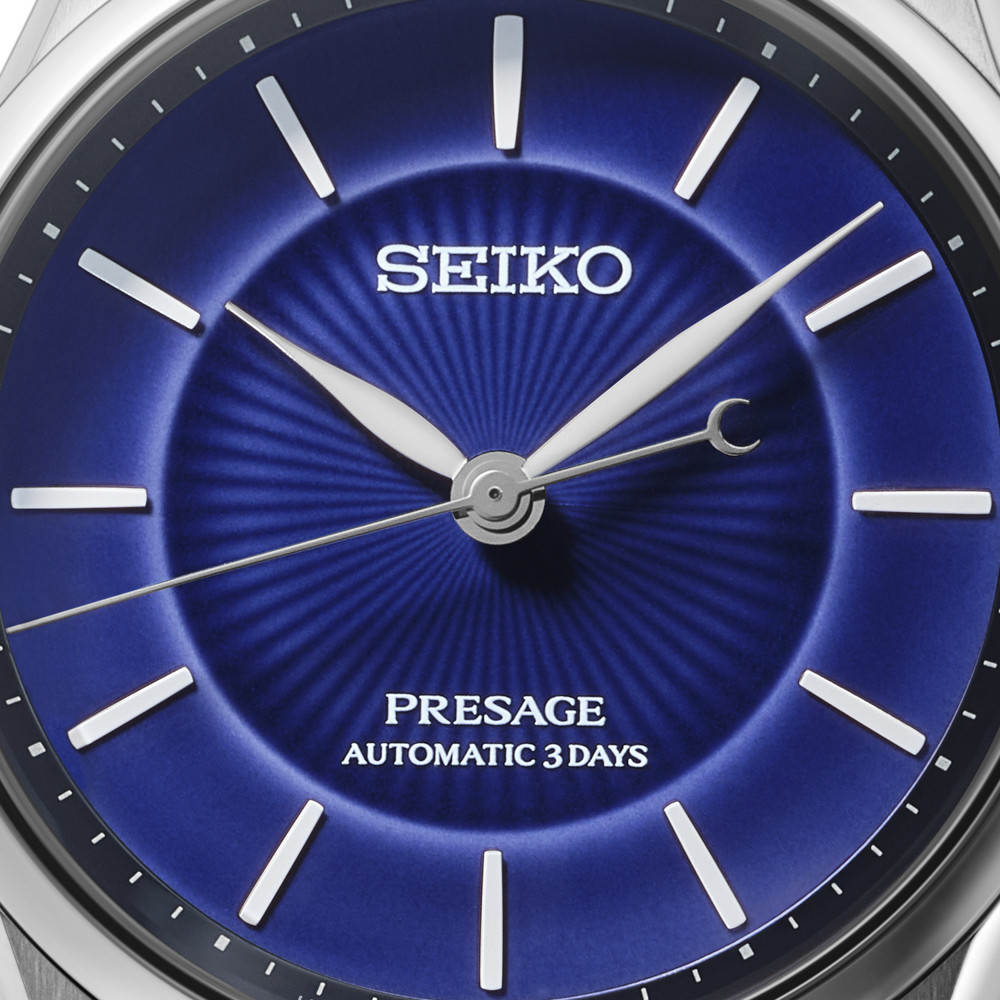
The Presage "Craftsmanship" series has always taken the position that a dial can be an object of art in its own right. The two anniversary editions arriving this season make that argument more compellingly than any Presage before them.
The Arita Porcelain edition in Ruri Blue is the one that stops people in their tracks. Arita, a small town in Kyushu, has been producing some of Japan's finest porcelain since the early 17th century, when suitable clay was first discovered in the region. The craft has evolved considerably in the four centuries since, but the essential nature of the process, hand-worked, hand-finished, irreducibly individual, has not. Every dial produced for this watch is unique. The slight variations in surface texture, the subtle colour shifts across the glaze, the tiny indentations left by the firing process: these are not imperfections. They are the proof of how the dial was made.
The shade is described as Ruri Blue, a reference to lapis lazuli, and it represents the deepest Arita glaze Seiko Presage has achieved to date. But the description does not prepare you for the actual experience of the dial. Under dual-curved sapphire crystal, the porcelain surface has a quality that photography consistently fails to capture: a sense of depth, almost topographical, that draws the eye inward. The longer one looks at it, the more the dial seems to recede and pull back, like a still body of water reflecting a sky it cannot quite contain. It is a calming blue, not the vivid electric of a sports watch, but something quieter and more considered. There is a reason collectors who handle this piece in person tend to linger on it.
The case measures 38mm, a size that has come back into its own in recent years and sits precisely where a dress-adjacent watch of this character belongs. The movement is Seiko's in-house 6R51 automatic, with a 72-hour power reserve, and the watch is paired with an LWG-certified sustainable leather strap. It arrives in its own special box. Only a small number of pieces have been allocated to the UK.
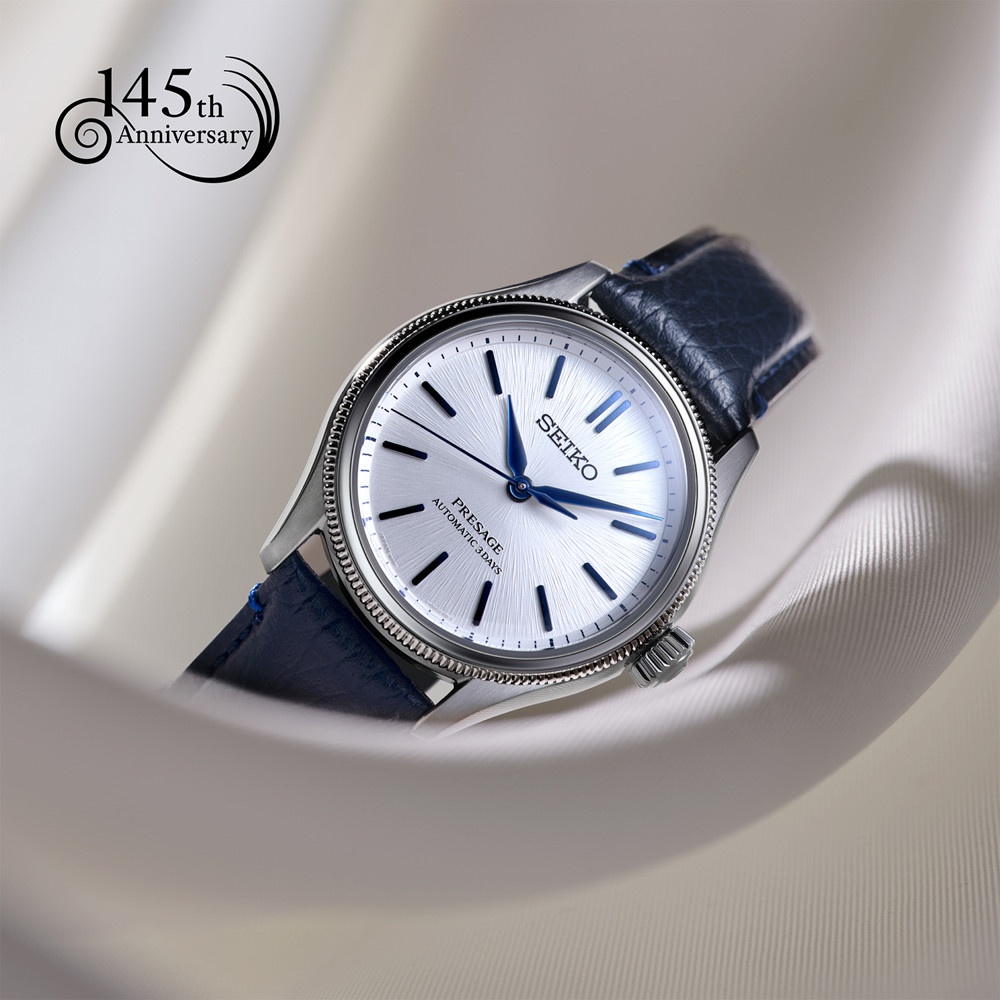
The Shiro-neri edition takes a very different approach to the same brief. Where the Arita porcelain dial communicates through depth and texture, the Shiro-neri dial communicates through restraint. The name refers to a stage in traditional Japanese silk dyeing, raw silk is refined until its natural creamy tone is removed entirely, leaving a pure, clean white. This is the base state before colour is ever introduced; the blank canvas. Seiko has taken that reference and applied it to a domed dial with curved hands and indices designed to maximise light reflections, housed under dual-curved sapphire glass. The effect is a watch that changes depending on how the light falls across it.
The coin-edge knurled bezel is worth particular attention. It gives the watch a classical character that collectors of a certain persuasion will find immediately familiar, reminiscent, in some respects, of the texture seen on the Presage Cocktail Time Sriracha, which generated considerable attention when it landed. It is a detail that grounds what might otherwise feel like a purely refined piece, giving it just enough presence on the wrist. Paired with a navy leather strap and the mirror-finished curved case, the overall effect is a watch that wears its influences lightly while remaining distinctly its own thing. Limited to 2,500 pieces globally.
Prospex, A Line With Something to Prove

The Prospex name, derived from Professional Specifications, has carried Seiko's tool watch ambitions since 1965. That year, the brand produced Japan's first purpose-built diver's watch. It was a significant moment in Japanese watchmaking, and it established the baseline against which every Prospex that followed has been measured.
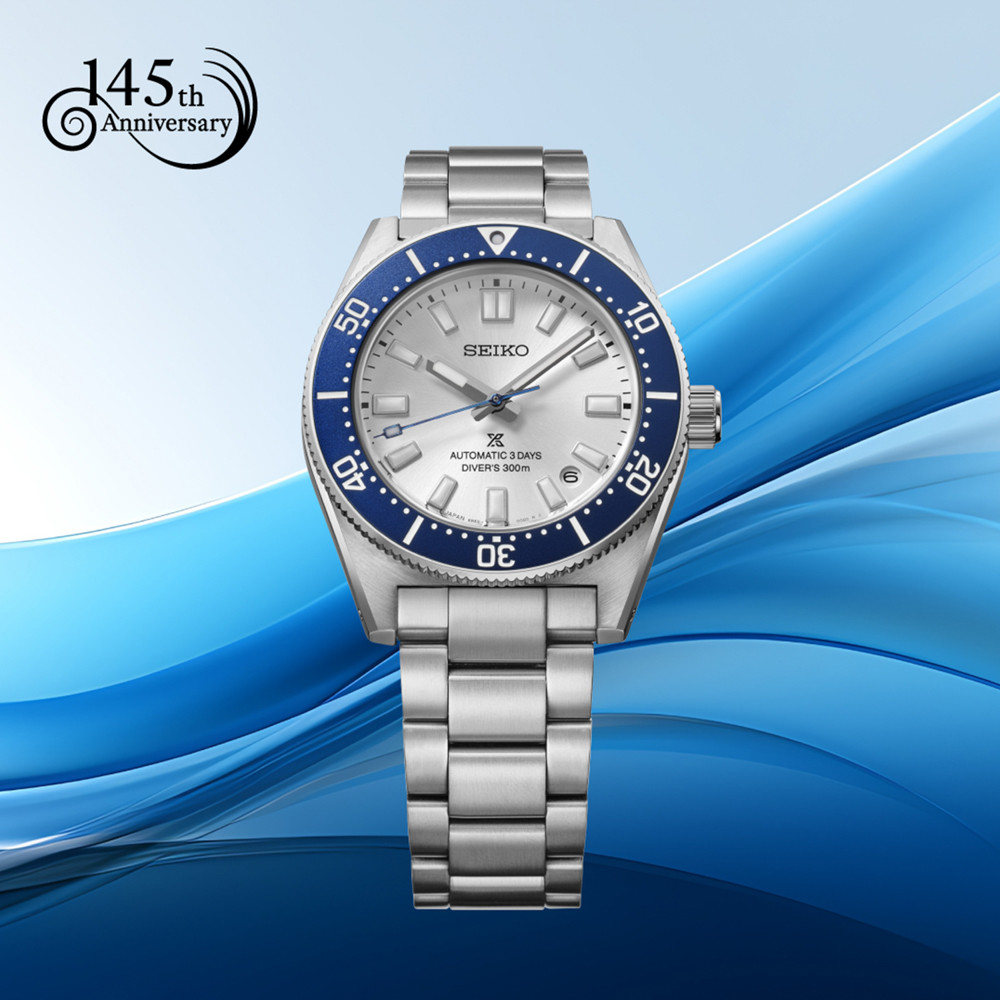
The 1965 Heritage Limited Edition in Silvertone is the more historically grounded of the two anniversary Prospex releases. The reference back to the original 1965 diver, often cited by collectors as one of the most important pieces in Seiko's history, and an ancestor of the famed 62MAS, runs through the design without being laboured. The silver dial carries LumiBrite on the hands and indices, the aluminium insert unidirectional rotating bezel is finished in Seiko Blue, and the 40mm super-hard coated case is rated to 300 metres. The movement is the in-house 6R55 automatic, delivering a 72-hour power reserve and accuracy of -15/+25 seconds per day. A limited-edition engraving on the caseback marks the occasion without drawing unnecessary attention to it.

The Samurai Mechanical takes a different route to the same destination. Where the 1965 Heritage is consciously retrospective, the Samurai leans into the identity Prospex has built for itself in the modern era. The case shape, angular, unmistakable, nicknamed by enthusiasts for its resemblance to a form cut by a Japanese sword, has become one of the most recognisable silhouettes in the diver segment at this price point. It is a 200m diver, again finished in silver with Seiko Blue accents, and again carrying a limited-edition caseback engraving. It is a watch that wears its confidence quietly: no brash colourways, no oversized proportions, just a well-resolved tool watch that knows exactly what it is.
Both Prospex releases are limited editions commemorating Seiko's 1881 origins, and both are built to a standard that makes a strong case for the Prospex line as one of the most genuinely capable diver's watch ranges available under £1,000.
Astron 5X63, The Most Technically Remarkable Watch in the Collection

Seiko invented the GPS solar watch. That is not a marketing claim, it is a verifiable fact. The world's first GPS solar timepiece came from Seiko, and the Astron line has carried that technology forward ever since. The 5X63 movement at the heart of this collection represents the current peak of that development.
To understand what the Astron actually does is to understand why it occupies a category of its own. The watch charges via natural or artificial light, no battery changes, ever. It connects to GPS satellites to determine its precise location anywhere on the planet and adjusts to the correct local time automatically. The 5X63 calibre also incorporates a 1/20th of a second chronograph and a 24-hour dual-time display. There are no manual corrections. There is no remembering to wind it, charge it, or update it after international travel. For anyone who has ever landed in a new time zone and spent the next hour working out which crown position adjusts the hour hand, this is a meaningful proposition.

The 145th Anniversary Limited Edition in White-Silver leads the Astron release. The embossed white-silver dial carries a gold-coloured dial ring and Seiko Blue accents, all framed by a sharply contoured multi-faceted bezel. The super-hard coated titanium case keeps weight low, and the low centre of gravity design makes it a natural fit for everyday wear. A two-toned white and blue silicone strap adds to the sport character.
Alongside it, the Tesselate 5X63 arrives in three colourways: Nebula Grey, Astral Onyx, and Celestial Gold. All three share the same embossed dial pattern and multi-faceted bezel architecture, differentiating themselves through palette and finish. Nebula Grey is the most restrained, a blue-grey that sits comfortably in almost any context. Astral Onyx takes the same geometry into a unified black execution. Celestial Gold adds a gold dial ring that shifts the contrast considerably, giving the watch a more assertive presence. All three come on titanium micro-adjustable bracelets with interchangeable clasps, a practical detail that matters more in daily use than it often gets credit for.
All four Astron 5X63 pieces share the same movement. That parity of capability across the range, whether you're drawn to the anniversary edition or one of the three Tesselate colourways, is worth noting. The technology does not vary by price tier or colourway. Every piece in this line does the same thing, equally well.

What This Collection Says About Seiko at 145
One hundred and forty-five years is a long time to keep making watches. The brands that survive that long tend to do so because they have learned to operate across multiple registers simultaneously, serving the collector who wants a hand-crafted artisanal dial, the enthusiast who wants a serious tool watch with genuine diving credentials, and the practical wearer who wants the most technically self-sufficient watch currently available. This anniversary collection does all three, without any of the three feeling like it was produced merely to fill a brief.
The Presage Arita Porcelain and Shiro-neri editions are among the most considered limited releases Seiko has produced in the Presage line to date. The Prospex 1965 Heritage and Samurai are straightforwardly excellent tool watches that do not require anniversary context to justify themselves. And the Astron 5X63 remains, by some margin, the most technically impressive watch available at its price point.
Not every piece will be for every collector. But across six watches, spanning three collections and three very different philosophies of what a watch should do, there is a coherent argument here, that at 145, Seiko is making some of the most interesting watches it ever has.